Green finance products for sustainable homes must meet new EU rules, experts warn
Green home certifications and mortgage products must align with new EU rules on green finance, the pan-European Smarter Finance for EU consortium has warned.

Green home certifications and mortgage products must align with new EU rules on green finance, the pan-European Smarter Finance for EU consortium has warned.

In this #BuildingLife Ambassador Spotlight Series, Passive House Plus is profiling leaders who have endorsed the Irish Green Building Council’s (IGBC) call to address the environmental impacts of buildings across their lifecycle.
In issue 38 of Passive House Plus we published an in-depth assessment comparing the build specs including five wall types to a typical Irish house. To enable the industry to fairly compare a broader range of build options, we now expand that analysis with the addition of four timber frame wall types and two insulated concrete formwork systems
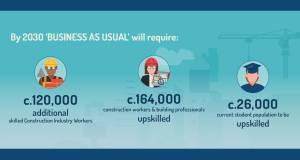
Research, led by Technological University of the Shannon, has identified significant skills and labour shortages in the built environment sector. The study highlights how this challenges Ireland in reaching its climate targets and points out possible solutions.
The week of live and online events will show how to accelerate our transition to a more sustainable and resource efficient built environment
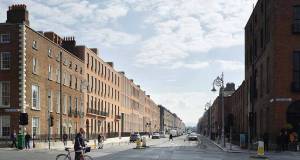
Sometimes a building comes along that asks challenging questions. Chris Croly, building services engineering director of BDP, describes one such example – a building designed to tackle the specific energy profile of offices, while trialling an innovative, dynamically controlled approach to adaptive comfort.
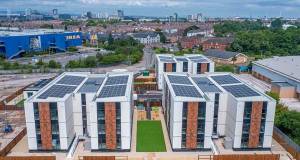
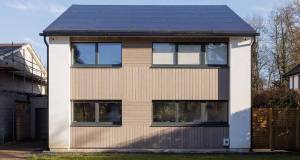
A passive house, by its nature, requires a much smaller amount of energy than a typical home, and when its heating demand is met by electricity, and you cover it in solar PV panels, you can start to see the potential for a whole new generation of passive homes that are semi-independent of the electricity grid. This is the case for Carrstone House in Bedfordshire, which generates so much solar energy it had to be registered as a power station.
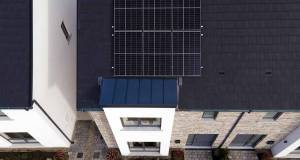
A new development in County Wicklow demonstrates how typical housing estates might be turned into electricity microgrids through solar power and battery storage, with residents buying and selling renewable energy from each other, helping to insulate them from price spikes and outages.
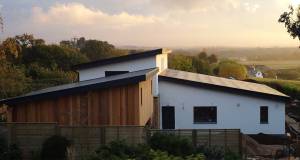
A passive house, by its nature, requires a much smaller amount of energy than a typical home, and when its heating demand is met by electricity, and you cover it in solar PV panels, you can start to see the potential for a whole new generation of passive homes that are semiindependent of the electricity grid. This is the case for Carrstone House in Bedfordshire, which generates so much solar energy it had to be registered as a power station.
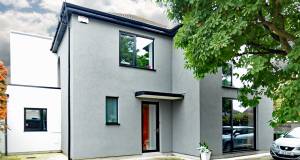
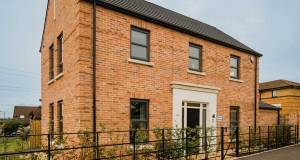
In trickier housing markets, the instincts of house builders have often tended towards building to the worst legal standards required – or worse. One award-winning new project in Belfast’s suburbs is showing that it doesn’t have to be this way – and that developers can thrive by pitching homes designed to ensure comfort and low bills at increasingly energy-conscious consumers.

Issue 43 featured an off-grid prototype house in British Columbia, designed and constructed to demonstrate an innovative approach to future building.
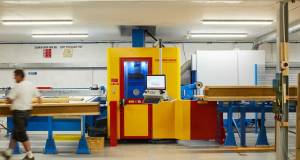
What do you get if you cross a quantum physicist, a forensic accountant, a merchant, an engineer and a software-whizz-kid architect? A terrible punchline presumably. But as Jeff Colley discovered on a trip to Sussex, you get something not to be laughed at: a collaborative approach that may be about to unlock a scalable, highly sustainable, circular economy-proof, flat pack build approach.
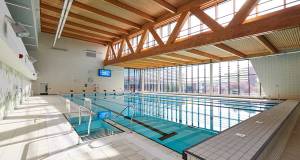
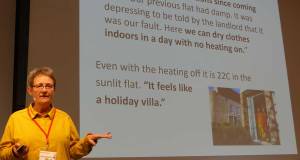
The potential of the passive house standard to change the world isn’t restricted to tackling climate change – it’s about social justice too.
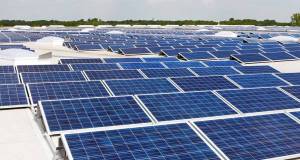
In a bid to increase the uptake of solar technology in Ireland as families and businesses continue to negotiate the energy and cost of living challenges, the Irish government has announced they intend to drop the VAT rate on the supply and installation of solar panels to zero.
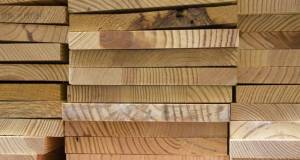
Mass timber comes into its own in terms of decarbonising tall buildings, which tend to rely on high embodied carbon materials such as steel and reinforced concrete. But regulatory change is needed to enable mass timber to fulfil its potential, as IGBC head of policy and advocacy Marion Jammet explains.

Actor Ed Begley Junior is one of America’s best-known and longest-standing environmental activists. Fresh from lighting up our screens in the final season of Better Call Saul, Begley spoke to Passive House Plus about the roots of his activism, and what drives him on in the face of such adversity.
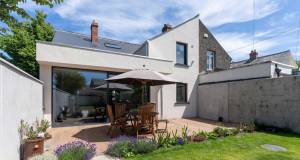
The skilful deep retrofit of a red-brick semi on the south side of Dublin has brought an old property into the 21st century in terms of energy performance and living space, while carefully upgrading its century-old façade with breathable materials.
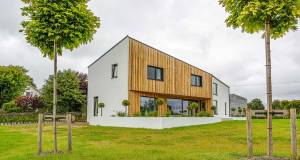
With emphasis in sustainable building shifting towards reducing embodied carbon, an obvious question comes into focus: is this an existential threat to the concrete industry? One passive house in Claregalway shows that – with a little help from Passive House Plus – concrete product manufacturers can make meaningful moves in the right direction.
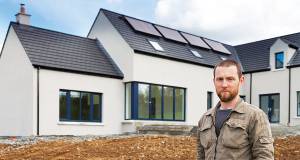
Editor Jeff Colley remembers Paul Doran, one of Ireland's foremost builders, who has tragically passed away.
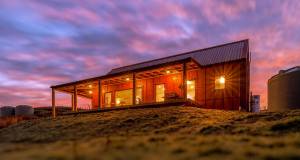
In the first installment of a brand new photo essay feature, in which we profile passive houses and other eco-buildings from around the world, architect Joe Lyth writes about how the aesthetic of simple backcountry cabins inspired the design of his rural home on New Zealand’s North Island.
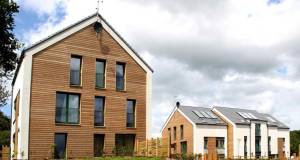
Part one of this article mini-series explained how vulnerable people are likely to respond to the energy crisis this winter. But what will happen to occupant health when people cannot afford to turn the heat on, and how will low energy buildings fare?

While most people will feel the squeeze as a consequence of the energy crisis, for vulnerable people spikes in energy prices may be a matter of life and death. In a two-part mini-series of articles in this issue, Kate de Selincourt peers into the void to see how vulnerable people may respond to high energy prices, and what the impact will be for their living conditions and their health.
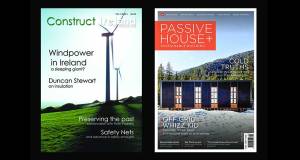
To kick start the new year, have a listen to co-founders Jeff Colley and Dan Hyde on what they've learned in the 20 years since our first issue came out.
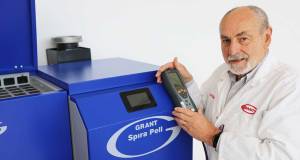
Leading heating technology manufacturer Grant has launched its new Spira Pell condensing wood pellet boiler.
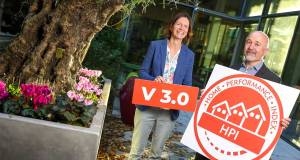
The Irish Green Building Council (IGBC) today launched a new version of its Home Performance Index (HPI) sustainable home certification system at its annual residential conference, Better Homes 2022. The focus of the event was on delivering low carbon homes at scale.
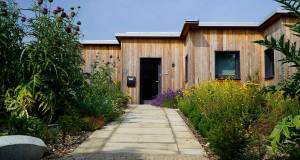
This home on the edge of the Cotswolds, built with cross-laminated timber, now holds the distinction of being the UK’s most airtight home, with the client even doing a significant chunk of the airtightness taping himself. What’s more, it demonstrates how passive homes that generate their own renewable power may escape the worst of the energy price crisis.
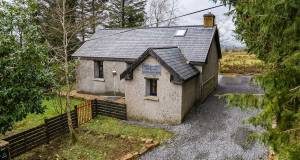
Rural Ireland has a crisis of dereliction, with numerous government policies aimed at breathing new life into thousands of old, vacant buildings. The careful transformation of one 19th century schoolhouse into a small, beautiful home shows a way forward for the sensitive, climate-conscious renovation of many of these properties.