
- Insight
- Posted
Embody language Part 3: A tipping point for domestic retrofit
Current life cycle carbon guidance was never designed for domestic retrofit. A new framework aims to change that – and to enable the impact of retrofit to be determined in terms of carbon and energy – as Dr Lois Hurst explains, in the third part of her series of articles on whole life carbon.
This article was originally published in issue 52 of Passive House Plus magazine. Want immediate access to all back issues and exclusive extra content? Click here to subscribe for as little as €20, or click here to receive the next issue free of charge
I think that by now you will realise that I have a bee in my bonnet. I want to evaluate the impact a domestic low-energy fabric retrofit has on the climate over its life cycle. I was dismayed during the early stages of my PhD research to realise that, because of constraints and limitations with how they are delivered, I had no confidence in life cycle assessment methods or data. When I had set out to identify whether operational or embodied impacts had a bigger share of a domestic fabric retrofit, and therefore whether retrofit was worthwhile at all, I found this realisation to be a bit of a barrier. If I was unable to establish the embodied impacts in a way in which I had confidence, how was I to answer my research question?
I came to the slow acceptance that I either had to a) make do with what is available and caveat all my findings, or b) work out everything from scratch according to my own made-up way. I did not have to think for too long to decide that option B wasn't really viable. I would spend the entirety of my PhD time – and probably the rest of my existence – trying to find reliable and robust data sources for infinitesimally small fragments of insignificant components of my retrofit, only to have to make assumptions left, right and centre, which would undermine the legitimacy of my findings. And of course, by the time I had done this, it would be too late for climate change; too late for retrofit. Option B was a non-starter. I would have to look again at option A.
This did not take long; there was no retrofit life cycle assessment guidance available. Actually, that's not entirely true – there is guidance available, but it hasn't been written specifically with retrofit in mind. For example, there is the Royal Institution of Chartered Surveyors (RICS) professional standard, Whole life carbon assessment for the built environment, second edition. There is the Royal Institute of British Architects (RIBA) paper, Embodied and whole life carbon assessment for architects, which directs users to RICS. And there is London Energy Transformation Initiative (LETI) Embodied Carbon Primer, which also directs users to RICS. The UK Green Building Council (UKGBC) Net zero whole life carbon roadmap and the LETI Climate Emergency Retrofit Guide offer broad principles and objectives for reducing embodied carbon, although do not offer full methodologies. The UK Net Zero Carbon Buildings Standard (pilot version) goes further than the other guides by setting out quantified limits for upfront carbon for domestic retrofit, and also specifies use of the RICS whole life carbon assessment to deliver this.
All the guidance I read was pointing me towards the RICS method, and so this was a sensible place to invest my efforts. They published their first edition in 2017, and a second edition in 2023, which was substantially more evolved. They do make provision for retrofit in their guidance. However, it seems to me to be framed as an exercise in evaluating the carbon impacts of retrofit, but as a “new” asset; one which assumes that if you do not retrofit this, you'll start with a brand new asset elsewhere. It seems more like a tool for corporate entities to manage their carbon impacts. It is very much not intended as a tool for optimising domestic retrofit design or choosing whether to retrofit or not. It is in contrast to the purpose I see for a life cycle retrofit assessment, which would foremost be one of design optimisation for the fabric energy measures, and for understanding whether the embodied impacts which are expended are paid off by the operational savings. A life cycle assessment at the design phase of a fabric retrofit could help us to understand the optimal extent of the retrofit being designed, or whether a particular building might never pay back the carbon invested.
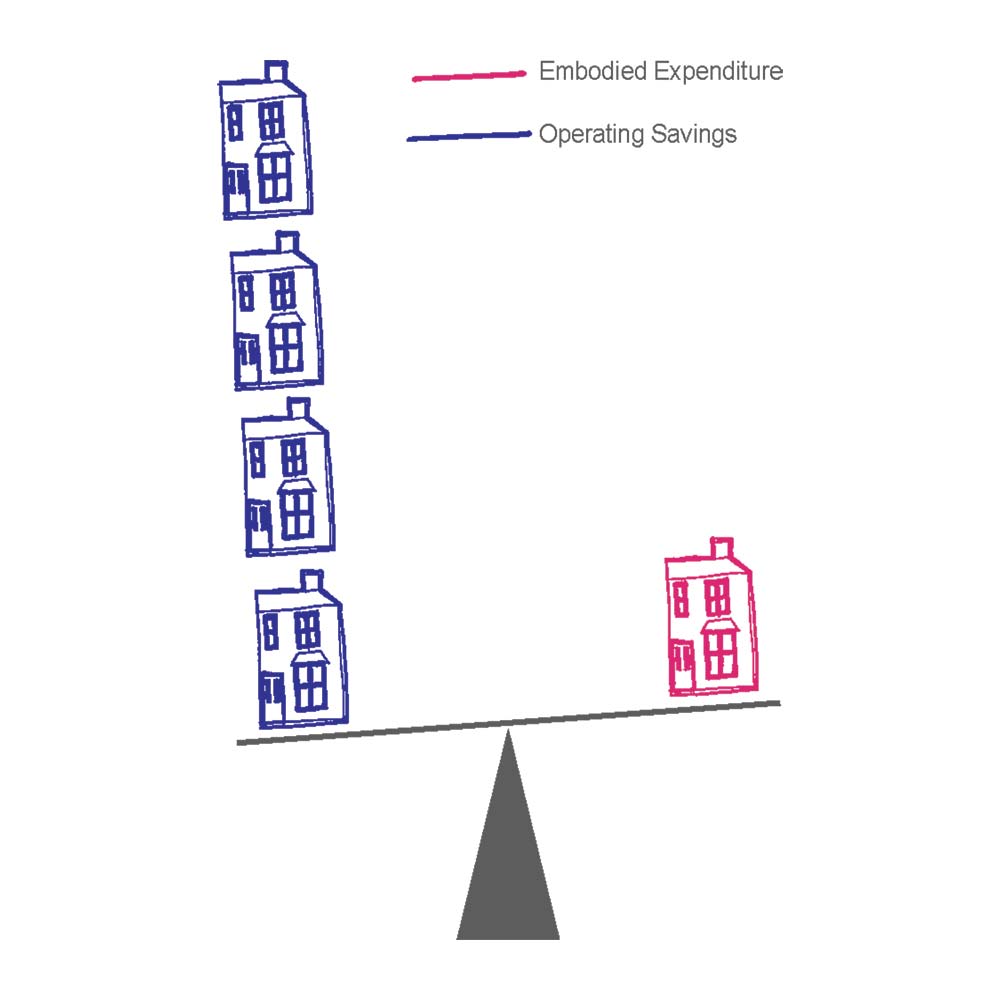
Figure 1: Schematic illustration of the operating and embodied impact (O:E) balance, or tipping point between operational savings and embodied expenditures, associated with a notional retrofit of an existing building.
This could reduce the extent of new renewable energy infrastructure required and therefore minimise the externalised embodied carbon expended on that.
It seems to me that only rarely would a life cycle assessment be undertaken to assist a decision of whether to build a new house or retrofit an old one – which would be the analogous scenario to the apparent purpose of the RICS guidance – perhaps with the exception of stock management for housing associations or large-scale landlords. And yet, faced with a need for twenty-six million retrofits by 2050, just in the UK, an informed decision-making process seems pragmatic.
However, the RICS method cannot deliver an assessment which helps to answer this question. For example, in the RICS analysis they include the maintenance and replacement and end-of-life impacts of retained elements (think of the impacts of cleaning windows or re-weatherproofing the facade). I argue that these impacts will occur whether or not the retrofit took place, so it is unfair to attribute them to the retrofit: these impacts are effectively already committed. They also reference the retrofit's impacts to the “total project gross internal area (GIA),” which could well include areas beyond the thermal envelope (i.e., an unheated garage). This conflates the impact with irrelevant areas of the site, and would have the effect of reducing the impact per square metre, and so it could be seen as advantageous to maximise the area of the site in order to present a lower embodied impact intensity; just another way to adjust the apparent carbon impact of buildings to suit disreputable means.
I was pleased to see that RICS does acknowledge that sunk embodied impacts associated with the existing building do not count towards the impact, stating that “retained elements from the original building are assumed to have no impact from their previous manufacture included in the A1–A5 assessment of a retrofit/refurbishment.” And additionally, they exclude the carbon benefits of onsite renewables to avoid “building-level trade-offs between operational and embodied carbon.” Both statements support a life cycle assessment for optimising a retrofit design.
But in general, when I tested the RICS method in practice for my research, I did find the methodology fell short when it came to meaningful evaluation for retrofits. It misses the opportunity to report energy, which we know can highlight efficiencies, and which can be masked when we look only at carbon. It conflates impacts of the retrofit and fabric performance with many other factors; impacts from other works on site and impacts associated with the energy carrier. And it can skew the results by giving it an irrelevant spatial reference.
In addition to these general limitations, I found numerous difficulties with calculating impacts associated with specific life cycle modules, because of assumptions which are inappropriate for retrofit, or because of data limitations. For example:
- Module A5.2 accounts for impacts associated with construction activities such as temporary works. RICS recommends a baseline of 40 kgCO2e/m² GIA for UK construction activities, which might include “tower cranes, hoarding posts, temporary sheet piling, temporary cofferdams” – few of which are commonly needed in domestic retrofit. The baseline therefore seems likely to overestimate impacts.
- Module A5.3 attributes impacts to the waste arising during installation of new materials, i.e., offcuts, packaging etc. It uses default rates from RICS waste rate data (table 18). However, retrofit materials are barely represented. Insulation is represented as a single entity; sheet or rigid materials like foil-faced polyisocyanurate (PIR) boards or wood fibre boards are not differentiated from formable products like batts, spray-on products like polyurethane (PU) foam or Diathonite, or loose-fill materials like cavity wall beads and cellulose fibre. Moreover, materials like fixings, sealants, membranes and tapes are entirely absent. How can a reasonable or objective estimate be derived if materials are not represented?
- Module B1 estimates emissions and removals from materials. Releases of greenhouse gas (GHG) from insulation blowing agents, CO2 reabsorption (carbonation) by lime and cementitious materials, and fugitive emissions of refrigerants, for example from heat pumps, are included in B1. However, RICS does not offer adequate data, sources of external data, or methodological guidance for these impacts to be calculated robustly. Many analysts would not have the resources available to obtain such information, leading to guesswork and subjective calculations at best, contributing to uncertainty.
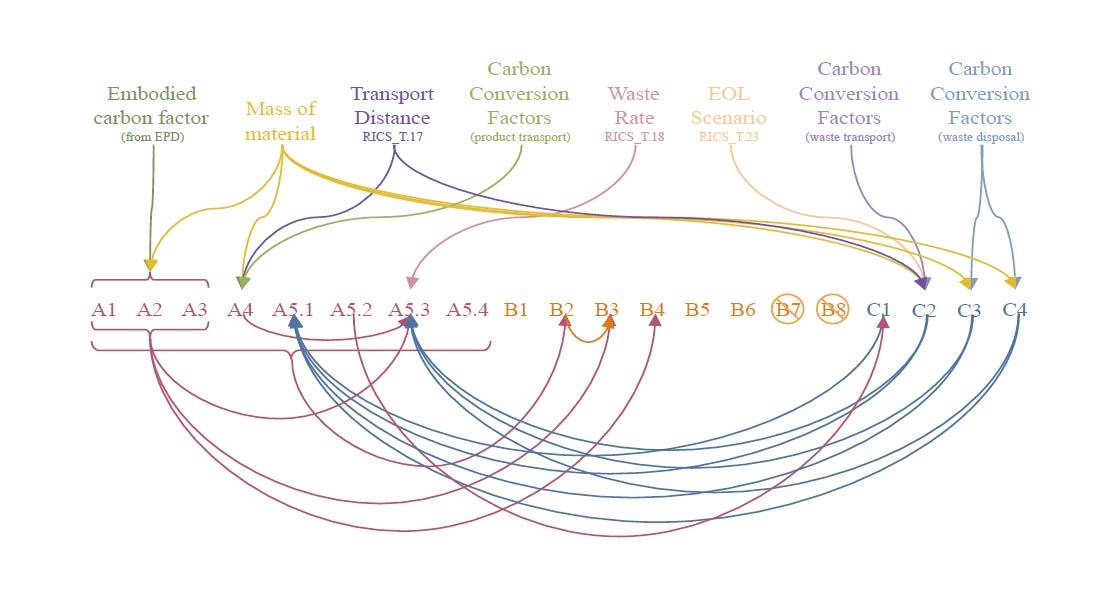
Finally, although most people do not undertake these calculations manually – and this is not specifically an issue with RICS – the calculations are complicated. The workflow for calculating the wholelife carbon has considerable interdependency and non-linearity compared to the simple module numbering set out in EN 15978:2011. I have developed a flow chart which schematically illustrates the data flow between modules, and indicates where data from the RICS guidance (e.g., tables containing default values for transport distances, waste rates and end-of-life scenarios), or externally sourced data (e.g. environmental product declarations (EPDs), material densities and masses) is needed for the calculations. And so when considering whether I'd pursue option A or option B from above, maybe I'm doing a bit of both: I have developed a set of amendments to the RICS method which better serve this purpose, some of which are described below (the full detailed framework is described in a paper published in Energy and Buildings):
- Energy should be reported as an impact factor as well as carbon, to identify efficiencies. This could reduce the extent of new renewable energy infrastructure required (on or off-site) and therefore minimise the externalised embodied carbon expended on that.
- In module B6, report only the energy required for space conditioning (heating, cooling and ventilation). This ensures that impacts are those relating to only the fabric retrofit interventions.
- For all modules, energy should be reported as final energy to ensure that changes in energy consumption are attributable to the retrofit interventions, rather than to changes in energy carrier (which are reflected in primary energy).
- Impacts should be reported per m² treated floor area (TFA), referencing the impact to the area treated, rather than to unrelated parts of the building.
- Omit existing assets from the study because they would have ongoing maintenance impacts whether a retrofit is undertaken or not.
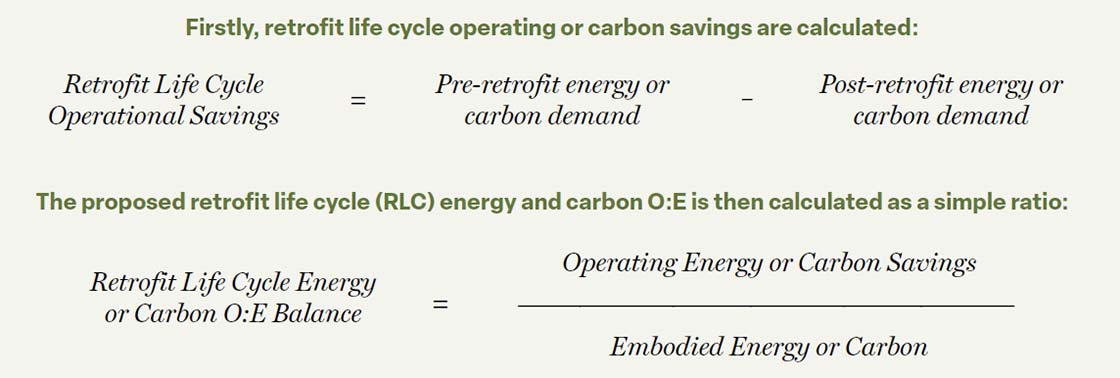
As an overarching approach to reframe how retrofits can be evaluated in life cycle terms, and in a way which ensures that the impacts being reported correspond to the fabric interventions made, the following tipping point has been defined.
The results from these equations then represent the retrofit tipping point. An RLC energy or carbon balance ratio of one or less indicates no overall life cycle energy or carbon saving from the retrofit. Alternatively, a ratio exceeding one indicates that there is “headroom” between the embodied impacts expended and the operating impact savings. In this case, subject to further technical considerations, the retrofit would be likely to be beneficial in terms of climate impacts.
Sometimes further analysis might then be desirable (i.e., looking at payback periods, etc.), but this approach offers a succinct and uncomplicated way of evaluating a retrofit, and comparing it to others. The recommended parameters for calculating embodied and operating energy will ensure a fair, objective and robust approach to defining the scope and boundaries of that energy or carbon calculation. These ensure that the results obtained correspond to the retrofit measures being proposed and therefore are not being conflated by external factors such as unheated spaces, energy carriers, and materials unrelated to the retrofit.
This approach is represented here as a proposal. It does require further development and I am currently seeking opportunities to take this forward. However, if you are keen to try out this approach, or if you have something you think you could contribute to it, please contact me – I would love to see this developed to the point where it can become a useful tool to make retrofits better.