

- Product News
- Posted
EU commissioner visits Ecocem as ACT cement line heads for 300,000-tonne capacity
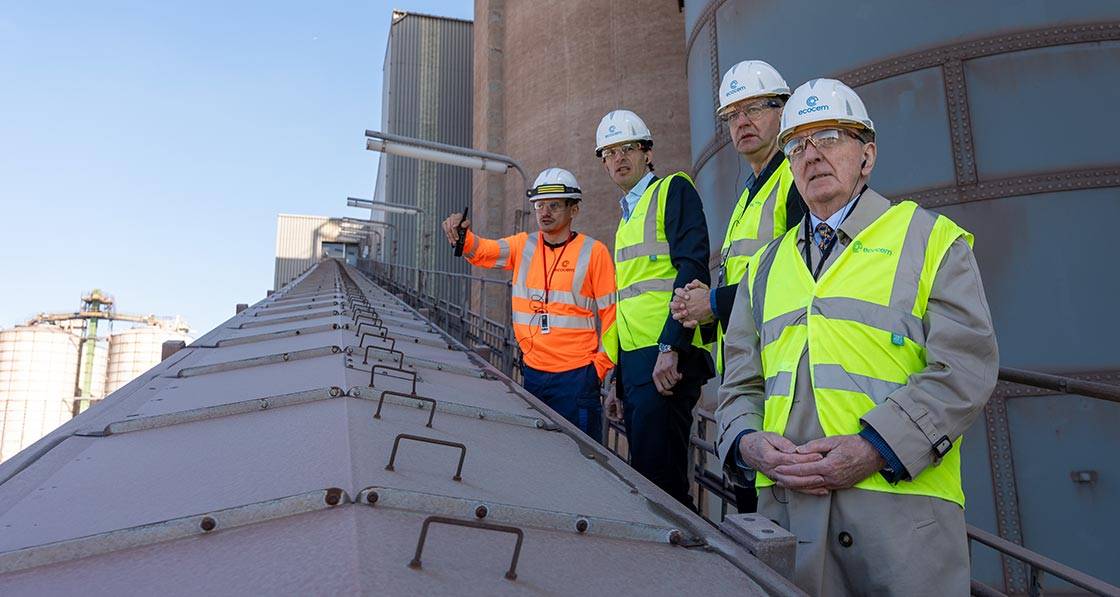
EU climate commissioner Wopke Hoekstra visited Ecocem's Dunkirk plant on 14 April, marking a moment of political visibility for a technology the Dublin-based company says can cut cement's CO₂ output by up to 70 per cent.
The visit centres on a €50m production line under construction at the site, dedicated to ACT, Ecocem's proprietary blended cement system. When operational at the end of 2026, it will produce 300,000 tonnes annually, supplementing the 700,000 tonnes of low-carbon cement the Dunkirk facility already outputs. The project forms part of a wider €220m European expansion programme the company is pursuing through to 2030.
Hoekstra said that following the Cement Dialogue earlier in the month, it was important "to get out of our offices in the Berlaymont and see real industrial decarbonisation on the ground."
The visit highlighted, he said, the EU's opportunity to take a leading position in decarbonising the global cement sector, combining climate objectives with industrial competitiveness.
"What I have seen here at Ecocem is exactly the type of solution Europe should be supporting as we accelerate industrial decarbonisation," he said.
Donal O'Riain, founder and CEO of Ecocem, said that scalable, cost-effective cement decarbonisation was "no longer a future ambition."
To unlock the technology's potential at scale, he said, Europe needed to create lead markets for low-carbon cement and secure scale-up funding for technologies such as ACT.
ACT works by displacing clinker, the calcination-intensive constituent that accounts for the majority of cement's CO₂ output. Conventional cement runs at 70 to 80 per cent clinker content; ACT brings this to 20 to 30 per cent, substituting it with supplementary cementitious materials (SCMs) and fillers, principally limestone and ground granulated blast-furnace slag (GGBS), with next-generation slag variants and calcined clays in development. Ecocem says the high replacement rates are achievable without performance compromise through a specific particle size distribution, novel superplasticisers and engineered mineral interactions, and that the formulation can be adapted to locally available SCMs, which underpins the global scalability claim.
In passive house construction, where operational carbon is so effectively suppressed, embodied carbon in concrete-intensive elements, including ground-bearing slabs, foundations and thermal mass, becomes a proportionally larger share of whole-life carbon.
Ecocem has operations in both Ireland and the UK, and says it intends to deploy ACT in both markets, as well as further afield via partners. In the UK, the product has been used in demonstration projects including Wembley Park; further demonstrator projects are planned across Ireland and the UK this year. Ireland's standards framework for structural concrete is undergoing revision, and Ecocem says full deployment in structural applications there depends on that process completing. An indicative EPD for the ACT range gives a global warming potential of just under 200kg CO₂ per tonne, which the company says would make it the lowest-carbon scalable cement on the market. Specifiers should note this figure is indicative; a certified EPD would be the reference point for specification and whole-life carbon assessment.The commissioner's visit follows the EU's proposed Industrial Accelerator Act, under which cement decarbonisation is positioned as central to European industrial competitiveness.
The commissioner's visit follows the EU's proposed Industrial Accelerator Act, under which cement decarbonisation is positioned as central to European industrial competitiveness.
Related items
-
 Armacell quantifies emissions avoided by insulation
 -
 Price regulation promised to address district heating affordability
 -
 ISO-Chemie joins permanent passive house exhibit in Matlock
 -
 From compliance to performance: reflections from Essen
 -
 Housing minister calls for faster retrofit to shield homes from energy shocks
 -
 £100m LSE retrofit to headline as passive house conference returns to London