
- Large Buildings
- Posted
World’s tallest passive house building certified in London
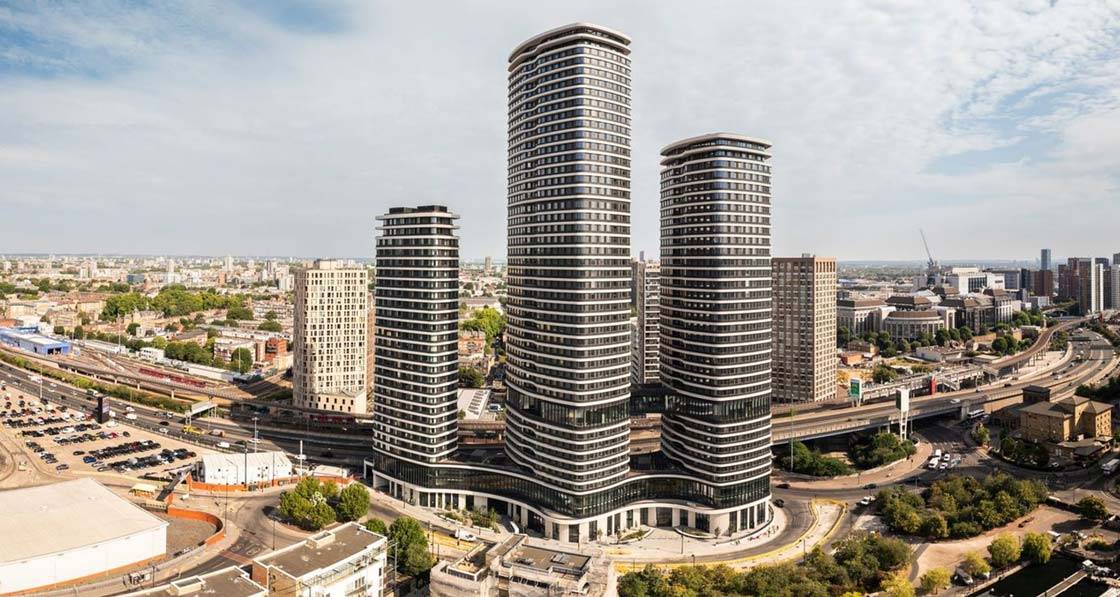
A new London building defined by a 46-storey, 138m tower has received passive house certification.
The building, Urbanest Canary Wharf, comprises three towers of 46, 36 and 28 storeys, is located in London's Docklands. When full, it will house 1,672 University College London (UCL) students, alongside 80 one, two and three-bedroom apartments.
The complex also includes 4,000 m2 of retail, office and education space, plus a drive-through McDonald's.
The building’s owner and operator Urbanest said that the development met the standard’s stringent performance requirements through high levels of insulation, airtight construction, high-performance glazing and heat-recovery ventilation. It also said it has achieved an outstanding air permeability result, significantly outperforming the level considered excellent within the industry.
Anthony Mellalieu, Urbanest’s chief operating officer, said the development set “new standards for sustainable student homes.”
“Following the certification of Urbanest Battersea in 2024, this latest achievement places Urbanest at the forefront of sustainable student accommodation, demonstrating that exceptional energy performance can be delivered at scale to support a high-quality living environment for our residents,” he said.
The development was delivered in partnership with UCL, with close collaboration across the wider project team which included JRL Group, Apt Architects, Henriksen Studio, Newmark, Walsh, Rider Levett Bucknall, MTT and LDA Design.
Describing the Canary Wharf development as a “fantastic achievement,” Joe Lay, director of accommodation at UCL, said: "This development delivers on many of the priorities at the heart of our accommodation strategy,” [and] “has been designed with sustainability embedded [and] introduces a significant number of affordable rooms to our portfolio".
Urbanest said residents will enjoy comfortable temperatures throughout the year and a continuous supply of fresh, filtered air, alongside substantially lower operational energy demand. The development also includes a gym, yoga studio, two cinema rooms, study spaces, games rooms and communal areas as well as seventy sky gardens to support student wellbeing.
Laszlo Lepp, managing director of the Passivhaus Institute in Austria and certifier of this project, said: “The buildings we create today shape the society of tomorrow. Certifying the largest passivhaus project worldwide proves that sustainability and social responsibility belong together.”