
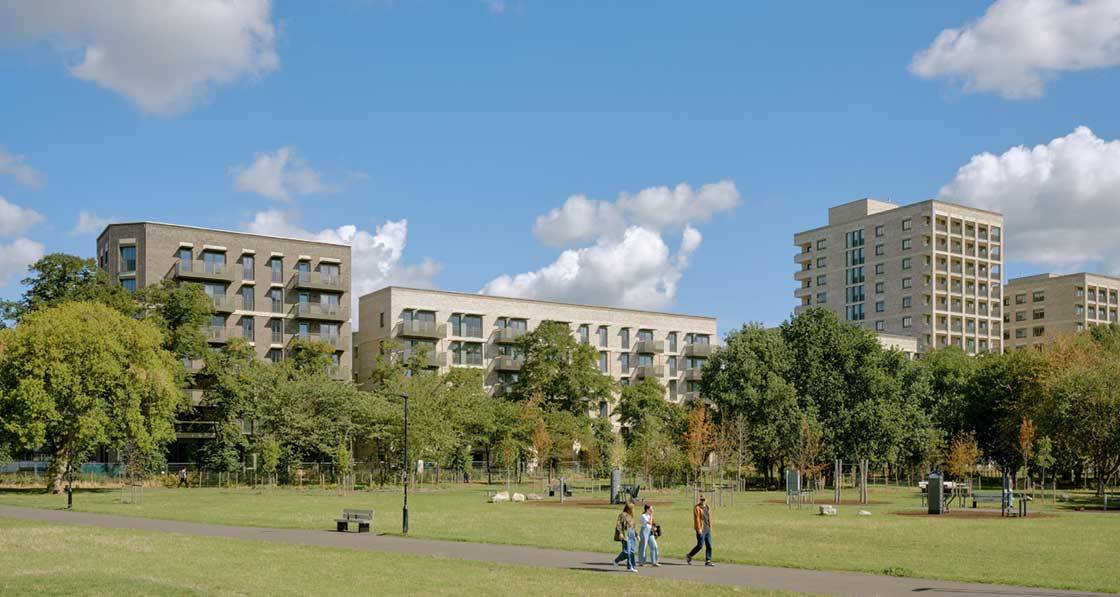

- General
- Posted
Study: passive house costs as low as 2%
The myth that energy-efficient building is a needless luxury has been dealt a significant blow by new research published by the UK’s Passivhaus Trust.
Want immediate access to all back issues of Passive House Plus and exclusive extra content? Click here to subscribe for as little as €20, or click here to receive the next issue free of charge
According to Costs and Value of Passivhaus: Optimisation, Capital Cost and Value Uplift, the extra cost incurred by meeting the passive house standard is negligible.
The report, co-authored by Currie & Brown, Elemental Solutions, and the Passivhaus Trust, found that the capital cost uplift of building to the Passivhaus standard can be as little as two per cent over standard Part L 2021 in England and Section 6 2021 in Scotland, never mind the lower running costs.
As the report points out, the cost increases are set to fall again next year due to forthcoming changes to building regulations in the UK, including the Future Homes standard for England and a Welsh equivalent, with Scotland’s planned passive house “equivalent” building regs to follow in 2028.
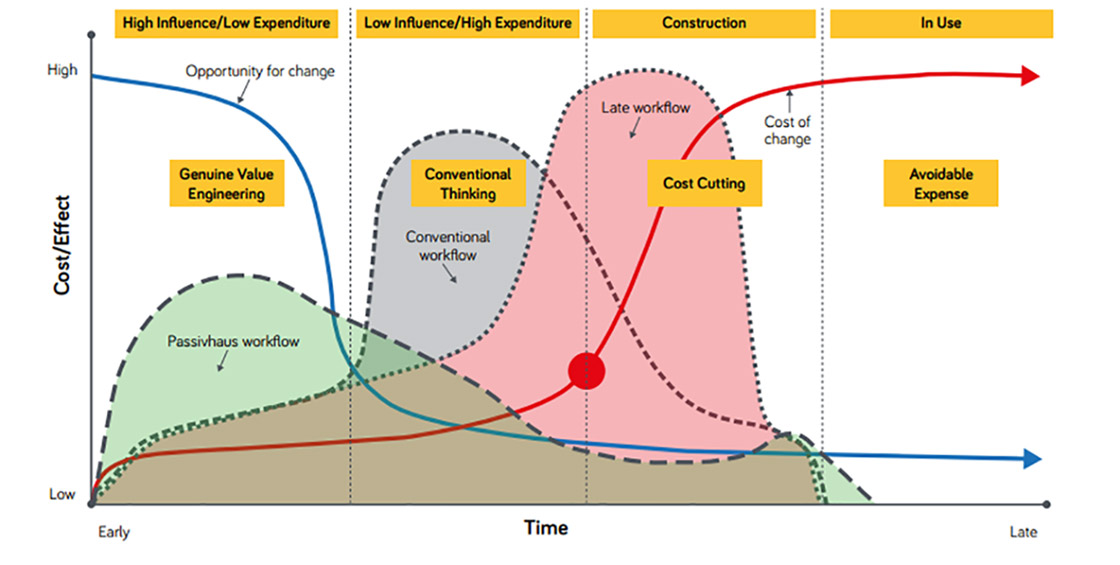
Graph showing effort concentrated at earlier work stages, creating more opportunity for a positive impact on cost.
Passivhaus Trust chief executive Jon Bootland says the research refuted the idea that cost is the chief barrier to delivering passive house-standard buildings.
“This new updated independent research shows that the uplift in capital cost is negligible. Passivhaus delivers lower running costs and greater confidence in real-world performance, helping close the gap between designed and delivered energy use,” he said.
The study, which notes passive house building geometry as key, also demonstrates wider benefits including comfort, health and indoor air quality, resilience to changing energy prices and climate risks.
The report draws on previously published modelling of the capital costs of passive construction compared with current building regulations. Modelling suggests that the capital cost uplift from current regulations for a semi-detached house is three to five per cent (£4,900–£8,500 per house), with mid-rise flats having an uplift of just two per cent (£4,100–£5,300 per flat).
Related items
-
 Widespread insulation failures found in EU tests
 -
 Kingspan fined €40 million by EU
 -
 Households feeling the heat of global oil conflict
 -
 New and enhanced Irish retrofit grants go live on 6 October
 -
 Glasgow scheme creates affordable rents fit for the future
 -
 Campaigners tell Irish government to publish Climate Action Plan