
- Events
- Posted
Futurebuild goes bigger without losing its soul
The UK's leading sustainable construction event is co-locating with two other shows in May.
This article was originally published in issue 52 of Passive House Plus magazine. Want immediate access to all back issues and exclusive extra content? Click here to subscribe for as little as €20, or click here to receive the next issue free of charge
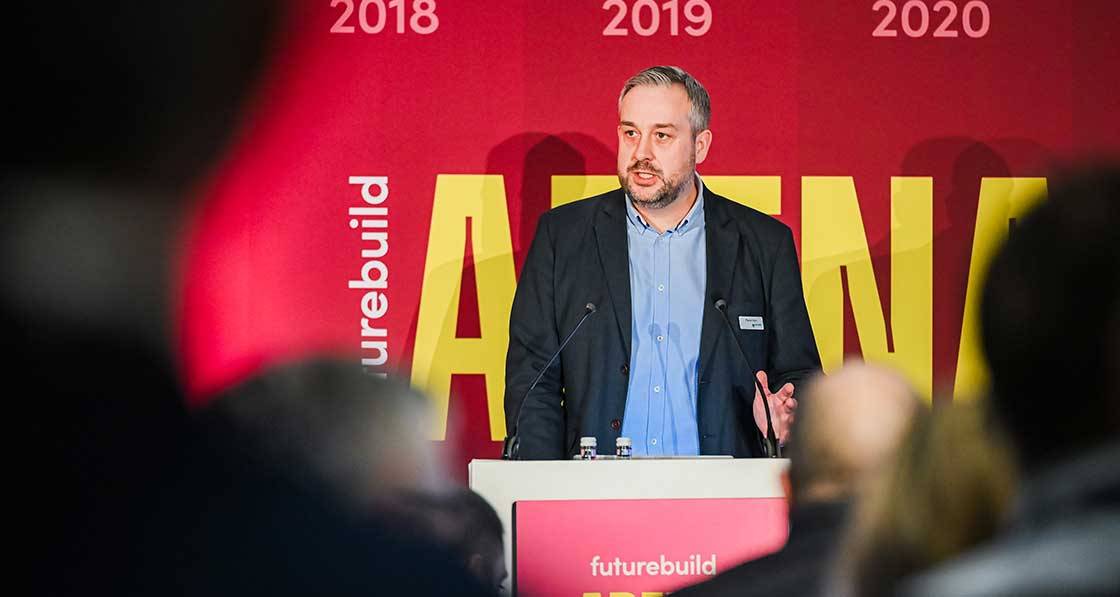
Futurebuild event director Martin Hurn says the merger is an opportunity to become more focused, not less."The big thing for me on a personal level," Hurn said, "is that Futurebuild isn't changing." He acknowledges that plenty of people have predicted otherwise, that the event would lose its identity, its mission, its carefully maintained distance from the generic construction trade show. The reality, he says, is different: he sees the co-location with UK Construction Week and a new stone and surfaces show differently. Not as a dilution, but as a clarification.
From 12 to 14 May at ExCeL London, three shows will occupy the same building. Each retains its own entrance, its own registration, its own website. Visitors who register for Futurebuild can move between all three on a single ticket, but the shows are being branded and marketed separately. For Hurn, the key point is what this arrangement makes possible rather than what it threatens.
"We can keep Futurebuild even more pure," he said.
The conference programme reflects this sharpened focus. Organised around what Hurn calls the three Rs – reuse, regenerative design and resilience – it is designed to stake out territory that no other construction event is occupying.
The question of greenwashing is one Futurebuild has always had to navigate, and Hurn is characteristically direct about its limits. With a team of four managing an event of this scale, systematically vetting every exhibitor's claims before the doors open is not realistic.
"The challenge is that we don't know a lot of the time what people are bringing to the show until I walk around that hall" he said. Stands are approved, but graphics and messaging are not. The honest answer, he says, is that the audience does much of the policing.
"We tell our exhibitors: come to the show but be prepared to be asked really difficult questions. Our specifiers will see through it." This approach is less about gatekeeping and more about creating the conditions in which weak claims get challenged. Curated pavilions, such as a Cradle to Cradle Institute area where only certified products are exhibited, and an ASBP section for member companies, provide zones of verified credibility within the broader show floor. An annual report produced with the Anti Greenwash Charter, published with an accompanying webinar, is Futurebuild's way of taking a formal position on the issue.
The more novel concern Hurn expresses if increasing numbers of brands retreat from their sustainability messaging altogether: what the industry has started calling green hushing. "Net zero is becoming a bit of a political weapon," he said, "and you're seeing a retraction of alignment with it."
Certification, he suggests, has not kept pace with the rush towards circularity as a marketing position: many companies are repositioning around circular economy principles without the Cradle to Cradle accreditation or equivalent verification to back it up.
Architects Declare has 100 square metres at the 2026 event. The conference features sessions on circularity and reuse with contributions from, among others, Julia Barfield and Duncan Baker Brown. The direction of travel, Hurn says, is deliberately away from the mainstream.
It was not always this way. Futurebuild's origins are in Ecobuild, a show that grew to considerable size before being sold in 2012 for £52m. Within a year, the government had withdrawn the feed-in tariff and the zero carbon homes initiative, and the event – by then heavily weighted towards solar and the incentive economy – began a prolonged contraction.
Hurn suggests the pre-sale version was probably never sustainable at that scale: "The size we're at the moment is probably the sustainable size it should be."
He describes the show as a barometer of market conditions; it’s floor plan a rough index of where the industry's attention is at any given moment. Offsite construction, briefly prominent, has contracted to almost nothing. Low carbon concrete was a dominant theme last year.
This year, circularity and biomaterials are growing – small stands, he notes, but active: "The bio guys are doing quite a lot at the moment."
The most significant structural shift in 2026 is the arrival of combined local authorities at the show for the first time. For Hurn, their presence signals a reorientation of where procurement decisions are being made – and where suppliers need to be visible. It is also a direct consequence of the Warm Homes Plan, which has begun to bring retrofit money into the system and with it a new class of buyer. The retrofit section of the show, he says, is growing as a result.
The conference is free to attend, funded by the exhibition. Hurn is forthright about the commercial logic: the show has to work commercially, and that is how the content programme – which he argues is as strong as any paid-for conference in the sustainable built environment sector – gets funded.
What he is equally comfortable saying is that the sustainability mission is not negotiable. Asked whether the culture war noise around net zero in the wider media affects what happens on the Futurebuild floor, his answer is essentially: not really, and that is precisely the point. The long-standing community of exhibitors and visitors – what he calls "the Futurebuild friends and family" – is not going anywhere. The show is theirs as much as it is his, and they are not in the mood to retreat.
Futurebuild takes place at ExCeL London, 12–16 May 2026. Click here to register for your pass, or visit www.futurebuild.co.uk for more information.